Extend Your Network Reach with Pluggable Amplifier Technology
Posted by Lakeisha Turks on May 20, 2026
As network operators push higher speeds across longer distances, a familiar tradeoff keeps resurfacing: extending reach usually means adding cost and complexity, along with specialized infrastructure to support it.
For years, the only way to go farther was to add more hardware, power, space, and operational overhead. But what if extending reach didn’t require adding another layer to the network?
That’s where pluggable erbium-doped fiber amplifier (EDFA) technology is transforming network design.
What Are Pluggable EDFAs?
In traditional optical networks, amplification exists as its own layer. Dedicated line systems, often deployed as separate chassis, are used to boost signals across long distances. While effective, this approach introduces added cost, consumes rack space, and requires teams to manage a separate optical infrastructure.
As networks scale, that model becomes harder to justify, especially when distance was the only reason for adding it. Pluggable EDFAs take a different approach.
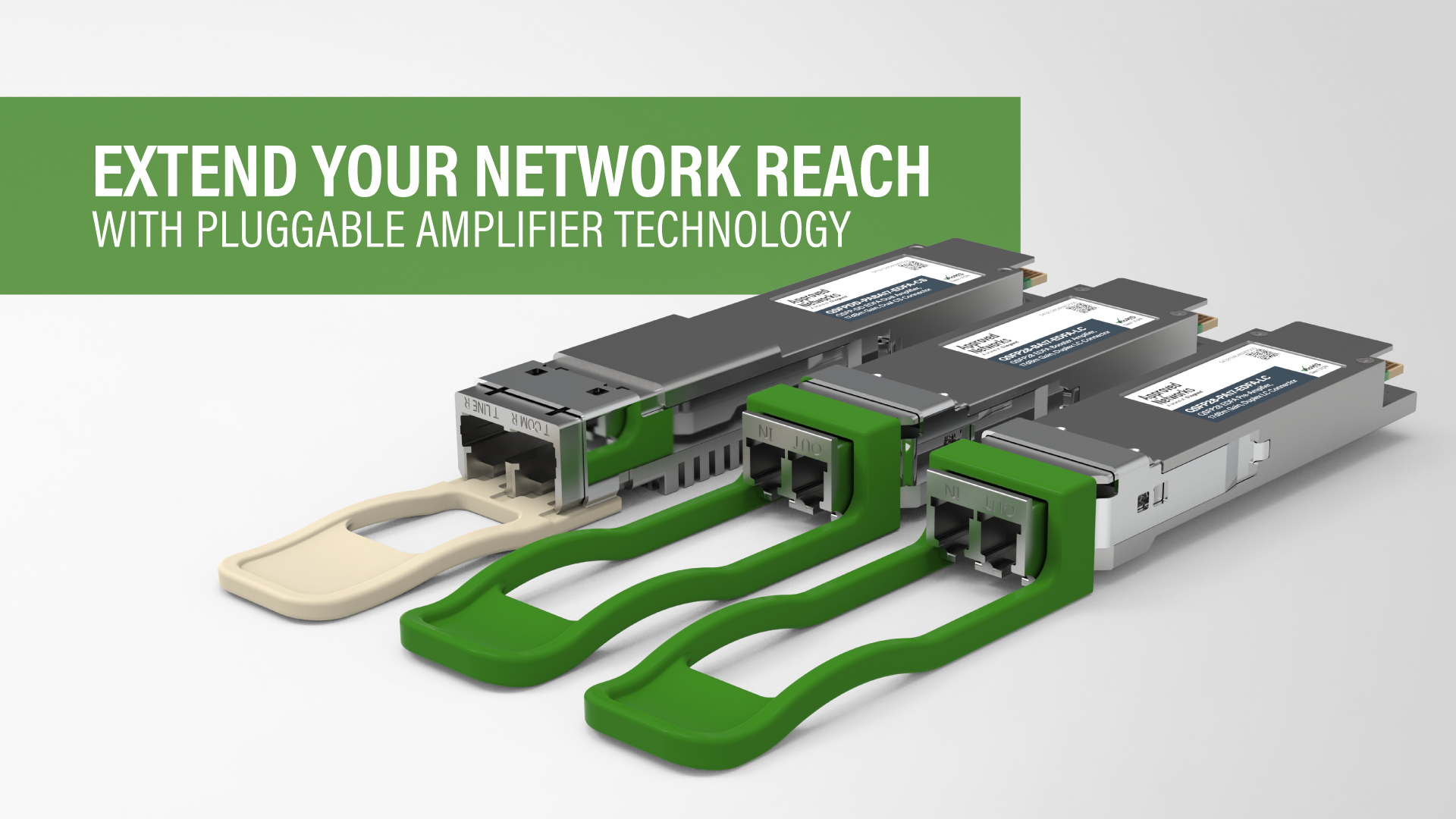
Pluggable EDFA modules amplify optical signals directly, eliminating the need for optical-to-electrical conversion. They are designed to fit standard transceiver form factors, such as QSFP28 and QSFP-DD. Instead of relying on bulky, standalone amplification equipment, these compact modules plug directly into existing switch or router ports—just like traditional fiber optics.
That shift changes more than just form factor. It changes how networks are designed and operated:
- No separate amplification hardware to deploy
- No additional rack space or power requirements
- No need for specialized transport systems or management layers
What was once a multi-layered architecture becomes a more integrated, streamlined design.
What this Means in Real Deployments
The challenge with distance isn’t just signal loss; it’s everything that comes with it.
A data center operator trying to connect facilities across a metro region may hit the limits of standard optics. Extending that link traditionally means introducing a full line system which adds cost and consumes space.
A service provider expanding into rural or underserved areas faces longer distances and tighter budgets. Adding dedicated amplification infrastructure can quickly make projects more complex.
Even within metro networks, scaling capacity often requires revisiting the architecture, adding more equipment just to support incremental growth.
Pluggable EDFAs change that dynamic by working within the existing network footprint. Instead of adding layers, they extend what’s already there, reducing time-to-deployment and enabling capacity expansion while minimizing space and power impact.
Flexible Amplification for Different Network Needs
Not every optical link faces the same challenge. Some spans struggle to push signal far enough at the start, while others arrive too weak to be reliably received. In many cases, both issues exist within the same link—especially as distances increase, and fiber conditions vary.
Pluggable EDFAs manage signal strength across the link, with multiple roles:
- Booster amplification increases signal power at the transmit side.
- Pre-amplification strengthens incoming signals at the receive side.
- Dual Amplification combines both functions into a single module, enabling simultaneous transmit-side boosting and receive-side amplification.
This versatility allows network engineers to optimize performance based on span length, fiber quality, and application requirements, without overhauling infrastructure.
Enabling Simpler IPoDWDM Architectures
Pluggable amplifiers play a critical role in enabling Internet Protocol over Dense Wavelength Division Multiplexing (IP over DWDM or IPoDWDM) architectures, a modern approach that simplifies optical networking by eliminating the need for separate transport layers.
With IPoDWDM, organizations can:
- Run high-speed ethernet directly over DWDM wavelengths
- Use standard switches instead of dedicated optical platforms
- Scale capacity without introducing operational complexity
By integrating amplification directly into pluggable modules, networks can overcome challenges like signal attenuation and optical loss while maintaining a streamlined architecture. There's no proprietary line system, no vendor-specific management plane, and no steep learning curve for network technicians already familiar with optical transceivers.
The result is a more efficient, cost-effective way to extend connectivity beyond 80km and support applications such as data center interconnect (DCI), 5G backhaul, metro and regional network expansion, rural broadband, and last-mile connectivity.
For a comprehensive technical overview of IPoDWDM, download Approved Networks’ white paper, “IPoDWDM: An Advanced Network Architecture”.
A Simpler Path to Scalable Optical Networks
As networks evolve to support higher speeds and longer distances, simplicity and efficiency are becoming just as important as performance.
Pluggable EDFA technology offers a cost-efficient path forward, combining the power of optical amplification with the convenience of standard transceivers. By reducing infrastructure requirements and enabling flexible deployment models, they empower organizations to scale their networks with confidence.
Every network has unique design and coding requirements. Contact Approved Networks for expert guidance about pluggable EDFA technology or IPoDWDM deployment.