Answering FAQs about Pluggable EDFA Technology Deployment
Posted by Lakeisha Turks on Jul 6, 2026
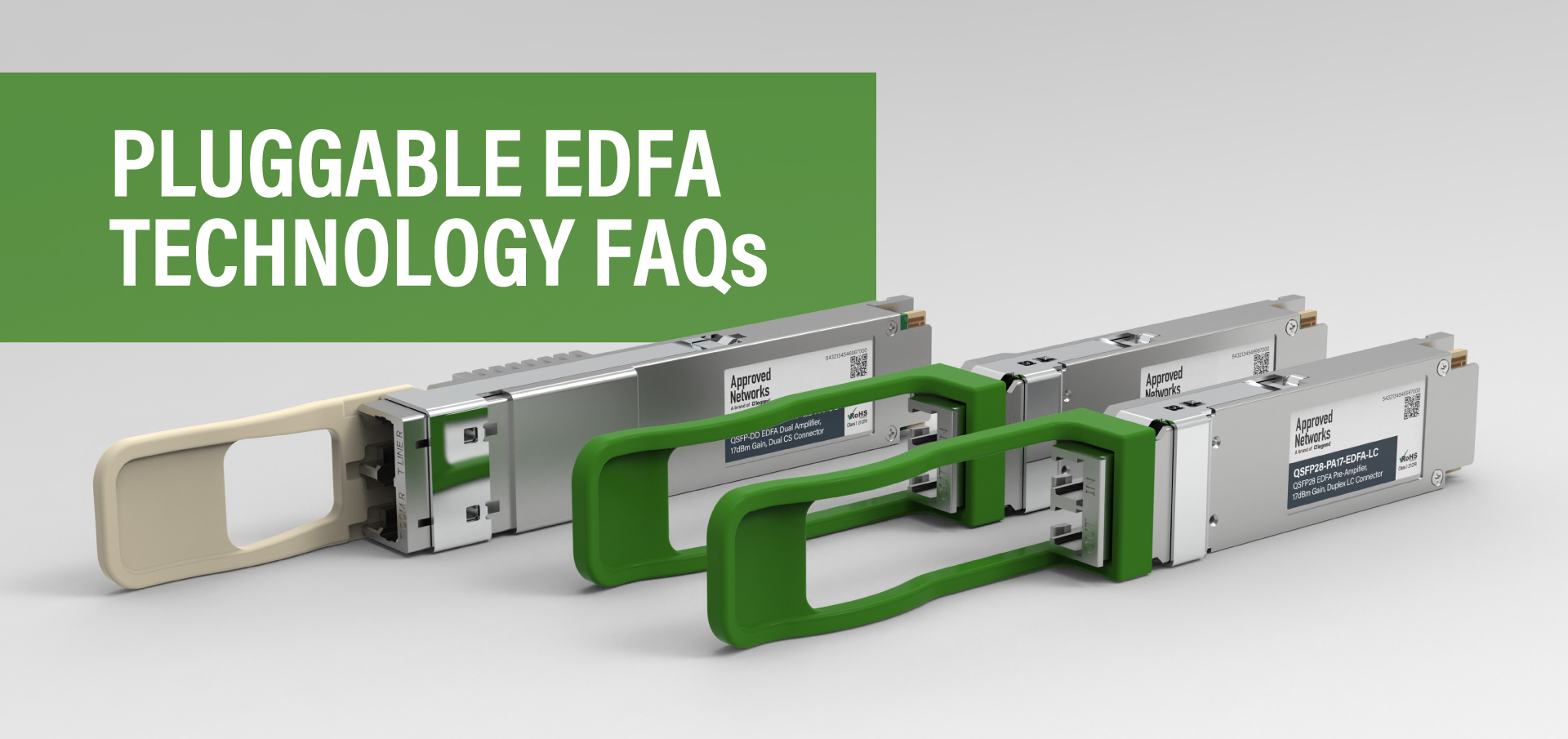
As network operators push higher speeds across longer distances, a familiar challenge continues to surface: how to extend reach without adding cost, complexity, or new infrastructure. Traditionally, achieving longer distances has meant introducing dedicated amplification layers, additional hardware, and greater operational overhead.
Pluggable EDFA technology is reshaping what’s possible by integrating amplification directly into a compact transceiver form factor, offering a simpler way to extend reach while reducing infrastructure demands. This shift raises important questions about performance, compatibility, scalability, and deployment in real-world environments.
Below, we answer some of the most common questions, breaking down how pluggable amplification simplifies optical networking while delivering the performance and flexibility modern networks demand.
1. How do pluggable EDFAs compare to traditional optical transport?
In traditional optical networks, amplification exists as its own layer. Dedicated line systems, often deployed as separate chassis, are used to boost signals across long distances.
Pluggable EDFA modules amplify optical signals directly, removing the need for optical-to-electrical conversion. Available in standard transceiver form factors such as QSFP28 and QSFP-DD, they plug directly into existing switch or router ports, like traditional fiber optic transceivers. This eliminates the need for bulky, standalone amplification systems while simplifying long-distance optical transport.
To learn more about the benefits of pluggable EDFAs read our article, “Extend Your Network Reach with Pluggable Amplifier Technology.”
2. Do we need a dedicated optical networking specialist to deploy pluggable EDFA technology?
To deploy pluggable EDFA technology, an optical engineer is typically needed during the planning phase to validate network design, compatibility, and performance requirements.
Pluggable EDFAs are designed to integrate directly into the same switch platforms and management interfaces your team already uses today. If your network team or deployment partner can install and configure QSFP transceivers, they can typically deploy pluggable amplification as part of the existing workflow—without a separate optical management system, standalone command line interface (CLI), or additional vendor support platform.
3. Has the 170km reach capability been tested and validated?
Extended optical reach no longer requires a separate amplification layer. By integrating amplification directly into pluggable optics, high-capacity DWDM links can maintain performance over distances up to 170km without relying on traditional amplifier chassis, reducing system overhead.
Approved Networks’ optical engineering team validated the 170km architecture through controlled lab testing designed to reflect real-world network conditions. Read our article, “Pluggable Amplifiers: Extending Your Network’s Reach,” for detailed testing methodology, operating conditions, and performance results.
4. What if we don’t currently have fiber between our sites?
For sites without existing fiber infrastructure, we can compare the economics of building fiber paired with pluggable amplification versus relying on long-term carrier wavelength services. In many cases, an owned-fiber approach delivers long-term cost savings, and because the amplification is pluggable, you maintain flexibility without being tied to a dedicated optical platform.
5. Can pluggable EDFA technology work with our existing passive DWDM filters?
Pluggable amplification can be deployed alongside your current passive DWDM infrastructure as new links are added, eliminating the need for a rip-and-replace approach. When evaluating a new route or expansion project, a side-by-side cost comparison can help determine the most efficient path forward.
Note: Pluggable EDFAs are not intended for use in active (powered) systems.
6. What if we don’t have the budget for a dedicated amplifier chassis?
Pluggable EDFA technology eliminates the need for a separate amplifier chassis and external power. These amplifier modules use standard transceiver form factors and plug directly into existing switch or router ports, just like traditional QSFP optics. That means no additional platform, standalone software, or maintenance contract on a separate optical system.
7. We need more than 8 DWDM channels. Can this scale?
Pluggable EDFA technology supports up to 8 DWDM channels, making it well suited for many metro and regional network deployments. For higher channel-count requirements, we can evaluate your architecture as part of a broader network design to determine the best approach for scalability and long-term performance.
Pluggable EDFA technology represents a shift in how optical networks are designed, bringing amplification closer to the network edge while simplifying deployment and reducing costs. To learn more about pluggable EDFA technology or schedule a network design meeting, contact our Approved Networks’ experts.