100G BiDi: Extending High-Speed Connectivity Over 80 km
Posted by Lakeisha Turks on Oct 8, 2026
More bandwidth doesn’t always require more fiber, but it does require making the most of the fiber already in place. As organizations upgrade to higher-speed connectivity, limited fiber availability, installation costs, and the challenges of expanding existing infrastructure can make adding new fiber difficult.
Bidirectional (BiDi) optical transceivers offer one way to address that challenge. By transmitting and receiving signals at different wavelengths over a single fiber strand, BiDi optics can support bidirectional communications while using half the fiber strands required by a traditional duplex connection. Today, that approach extends beyond shorter-distance applications, with 100G BiDi transceivers supporting up to 80 km over a single fiber strand. This makes BiDi an ideal solution when fiber resources are limited, but additional capacity and reach are needed.
Traditional Two-Strand Fiber Connectivity

BiDi Single-Strand Fiber Connectivity

As data rates have increased, so has the capability of BiDi technology. What was once commonly associated with lower-speed, shorter-distance applications is now available for 100G connectivity, including solutions designed to reach significantly farther which is useful for data center interconnects (DICs), campus and enterprise networks, telecommunications infrastructure, and service provider networks where adding new fiber is costly or impractical.
More Bandwidth and Reach with 100G BiDi
The primary advantage of 100G BiDi is its ability to deliver high-speed connectivity while reducing fiber consumption. Using fewer fiber strands can also reduce the number of associated patching resources required for a connection. Depending on the network design, this can help simplify fiber management and make better use of available space.
Earlier BiDi deployments were commonly associated with applications such as point-to-point connections, access networks, and shorter-distance links. Today, 100G BiDi solutions extend the technology into higher-bandwidth applications and longer-reach network architectures. This evolution gives network designers a practical option for increasing bandwidth when additional fiber is cost-prohibitive.
Extending 100G Connectivity Over Longer Distances
Not every 100G connection is confined to a data center or building. Organizations may need to connect facilities, network locations, or other infrastructure across significantly greater distances while working within existing fiber constraints.
This is where extended reach 100G BiDi becomes particularly valuable. Depending on the specific transceiver, fiber type, and link design, 100G BiDi solutions can support significantly longer distances than the shorter-reach applications traditionally associated with BiDi. Extended-reach implementations are available for single-mode fiber and can be designed for long-distance point-to-point connectivity.
For applications requiring connectivity across distances of up to 80 km, a properly specified 100G BiDi solution can provide high-speed connectivity while using a single fiber strand.
What to Consider Before Deploying 100G BiDi
BiDi can be an effective way to conserve fiber, but several factors should be considered when designing a BiDi link.
- Available Fiber
BiDi can be particularly valuable when the number of available fiber strands is limited. Using a single strand for bidirectional communications can help preserve additional strands for future connections or other services. - Distance
BiDi reach varies by transceiver. Shorter-reach and extended-reach optics are designed for different applications and fiber types, so the selected optic must match the required distance and link conditions. - Fiber Type and Link Budget
The fiber infrastructure and total optical loss of the link must be compatible with the selected transceiver. Single-mode fiber is used for long-distance applications, while multimode fiber is typically associated with shorter-reach applications. - Matched Transceivers
BiDi optics must be deployed as compatible pairs. The transmit and receive wavelengths at each end must be matched correctly for the link to operate as intended. - Network Architecture
The best optical solution depends on the application’s performance, scalability, and connectivity requirements. A single high-speed point-to-point connection may be well suited to BiDi, while the requirements of a particular network design may call for a different optical approach.
Making Better Use of Existing Fiber
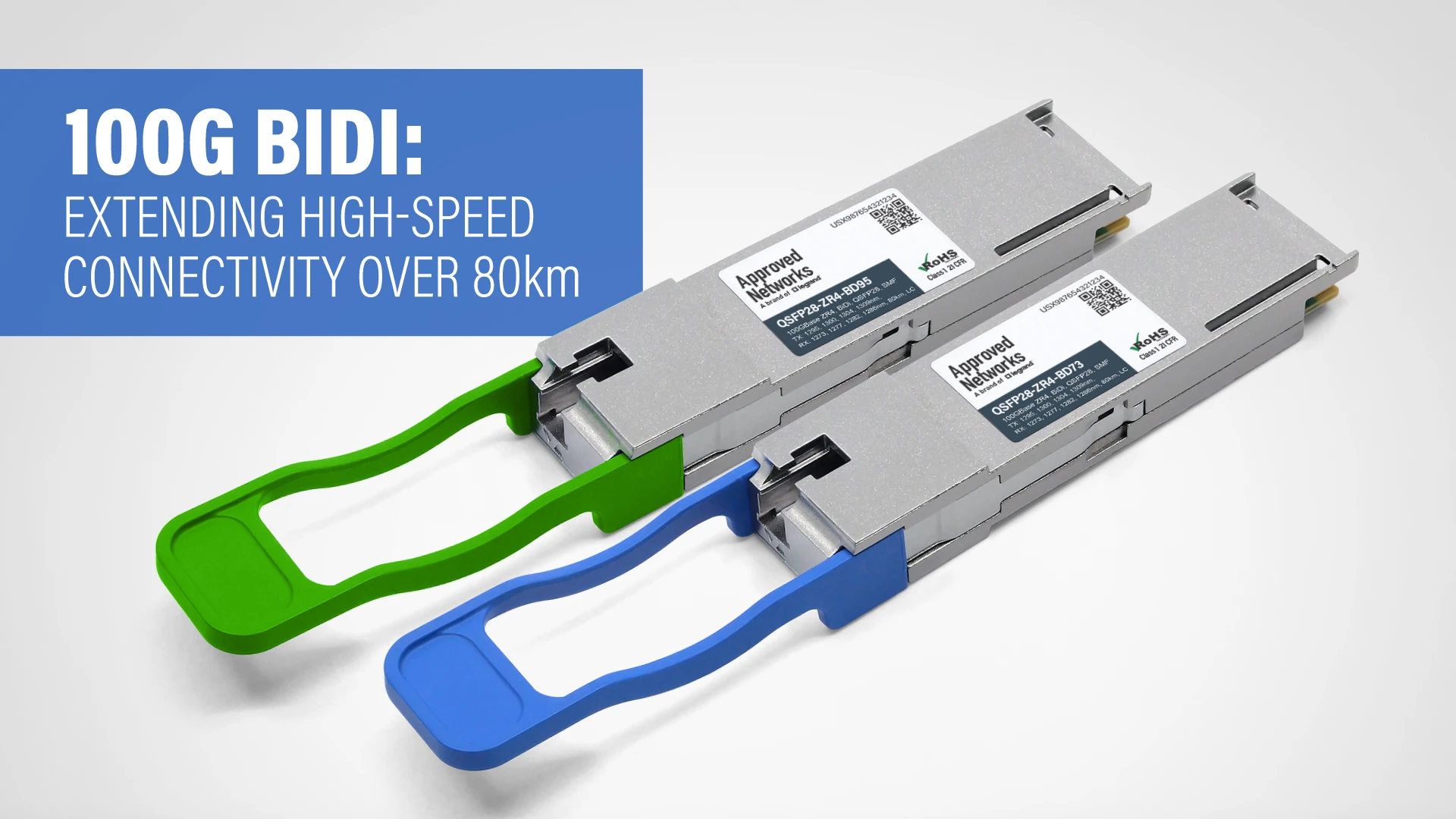
Approved Networks 100G QSFP28 ZR4 BiDi transceivers support up to 80 km of reach, bringing single-fiber 100G connectivity to applications that extend well beyond traditional short-distance BiDi deployments.
That extended reach makes these transceivers well suited for long-distance, point-to-point connections between data centers and campus network locations. By combining 100G connectivity with single-fiber operation, they give network designers greater flexibility when planning high-speed links.
For high-speed connections where distance and fiber availability both matter, Approved Networks’ 100G QSFP28 ZR4 BiDi provides another way to connect more while using less fiber.